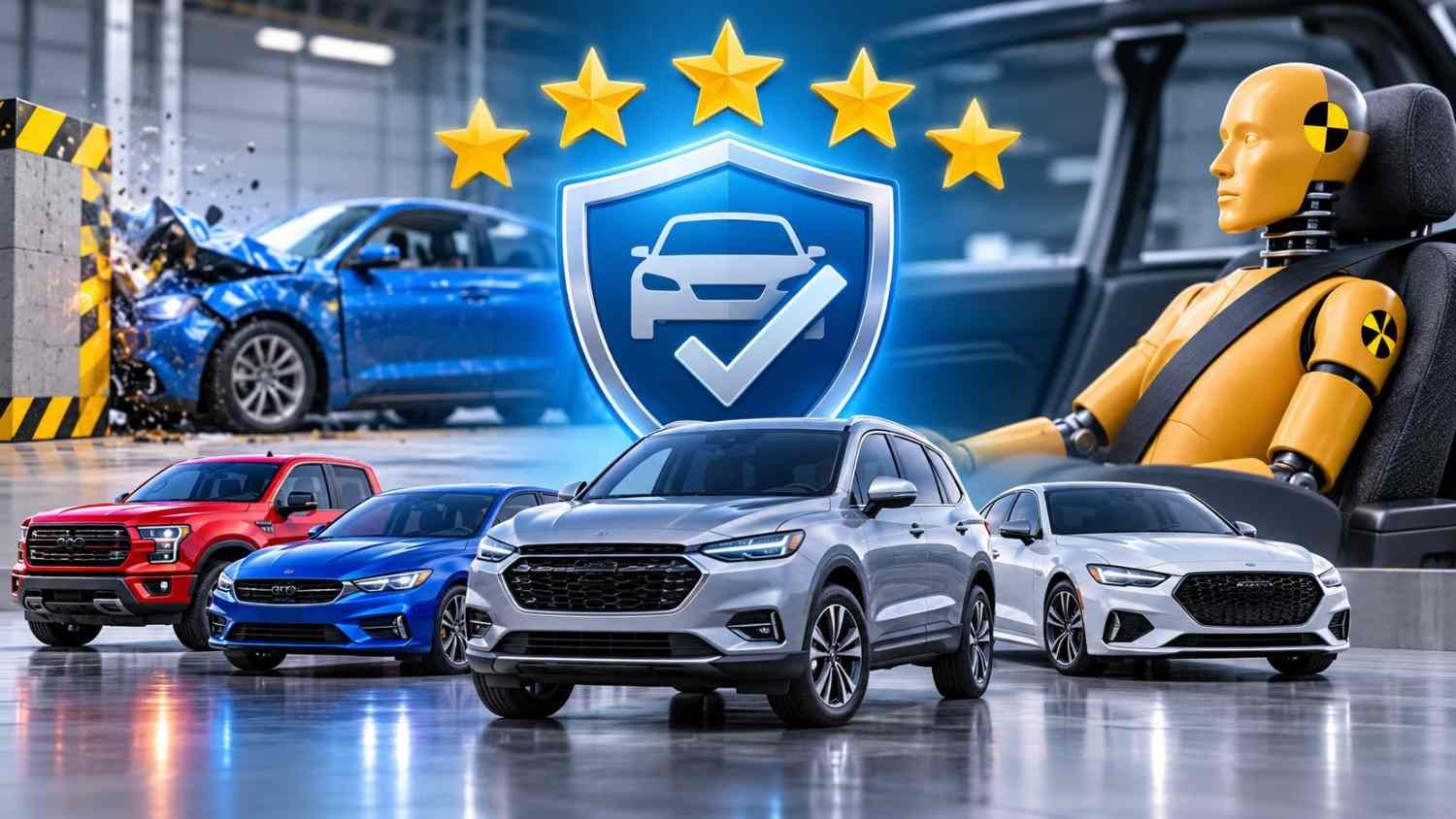
Buying a new car in the United States involves more than comparing prices, fuel economy, technology, and exterior design. Safety should be one of the most important factors in the decision. Whether you are considering a compact sedan, a family SUV, a pickup truck, or an electric vehicle, understanding how well a vehicle protects its occupants can help you make a more informed purchase.
For the 2027 model year, vehicle safety testing is receiving additional attention. The National Highway Traffic Safety Administration (NHTSA) has announced its latest vehicle testing selections, while new pedestrian protection assessments are bringing another part of vehicle safety into focus. The Insurance Institute for Highway Safety (IIHS) also continues to evaluate vehicles through its own crash tests and crash-prevention assessments.
However, a vehicle being selected for testing does not automatically mean it has received a five-star rating or an IIHS safety award. Buyers need to understand what these ratings measure, where to find official results, and how to use that information when comparing vehicles.
Here is what you should know about 2027 vehicle safety ratings before choosing your next car.
What Are 2027 Vehicle Safety Ratings?
Vehicle safety ratings are assessments designed to help consumers understand how well a vehicle performs in certain crash situations and how effectively its safety systems may help prevent accidents.
In the United States, two major organizations provide widely used vehicle safety assessments:
- NHTSA: The National Highway Traffic Safety Administration operates the government’s New Car Assessment Program (NCAP), which includes its familiar 5-Star Safety Ratings.
- IIHS: The Insurance Institute for Highway Safety is an independent research organization that evaluates vehicle crash protection and crash-prevention technologies.
Both organizations test vehicles, but they do not use identical testing procedures or award systems. A vehicle may receive different results from NHTSA and IIHS because each organization evaluates safety from its own perspective.
For buyers researching 2027 models, checking both sources provides a broader picture than relying on a single rating.
How Does NHTSA’s 5-Star Safety Rating System Work?
NHTSA’s 5-Star Safety Ratings program helps consumers compare the crash protection and rollover resistance of new vehicles. It uses a star-based system, with five stars representing the highest rating and one star representing the lowest.
The program focuses on three major areas of crashworthiness.
1. Frontal Crash Protection
Frontal crash testing evaluates how well a vehicle protects its occupants in a simulated head-on collision. NHTSA examines the likelihood of injuries to different parts of the body using crash-test dummies equipped with measurement instruments.
This assessment helps buyers understand how a vehicle’s structure and restraint systems perform in a frontal impact.
One important detail is that frontal crash ratings should generally be compared between vehicles in the same weight class. NHTSA recommends comparisons within approximately 250 pounds because vehicle weight can affect the results.
2. Side Crash Protection
Side-impact collisions can be particularly dangerous because there is usually less structural space between the occupants and the point of impact.
NHTSA’s side crash tests examine how well a vehicle protects occupants when another vehicle or barrier strikes its side. The testing helps evaluate the vehicle’s structure and safety systems under different impact conditions.
Unlike frontal ratings, NHTSA says side crash results can be compared across vehicle classes because the vehicles are evaluated using the same impact force.
3. Rollover Resistance
Rollover resistance is another important part of NHTSA’s safety evaluation.
Vehicles with a higher center of gravity, including some SUVs and pickup trucks, may have different rollover characteristics from lower passenger cars. NHTSA evaluates rollover resistance to help consumers understand the risk of a vehicle rolling over in a single-vehicle crash.
This information is particularly useful when comparing SUVs, crossovers, and trucks.
Why does the overall rating matter?
NHTSA combines information from frontal crash, side crash, and rollover assessments to calculate an overall vehicle score. A higher star rating generally indicates a lower estimated risk of injury in the types of crashes included in the program.
Still, no rating can guarantee that occupants will avoid injuries in every accident.
Important 2027 NHTSA Vehicle Testing Updates
One of the biggest developments for the 2027 model year is NHTSA’s expanded focus on vehicle testing and pedestrian protection.
On October 15, 2026, NHTSA announced its selected 2027 model-year vehicles for its New Car Assessment Program.
The agency identified:
- 23 vehicles for frontal, side, and rollover crash testing.
- 18 vehicles for pedestrian protection assessments.
- 10 vehicles for advanced driver assistance system verification testing.
The selected vehicles include models from manufacturers such as Hyundai, Kia, Nissan, Lexus, Toyota, Volkswagen, BMW, Jeep, and Tesla.
These announcements are useful for car buyers because they show which vehicles are included in the agency’s testing program. However, selection for testing should not be confused with a published final safety rating. Buyers should check NHTSA’s official ratings database for the latest available results.
New Pedestrian Protection Tests: Why They Matter
Vehicle safety is not only about protecting the driver and passengers. Pedestrians are also vulnerable when a vehicle is involved in a collision.
For the 2027 model year, NHTSA has introduced pedestrian protection assessments as part of its New Car Assessment Program. These evaluations examine how vehicle design may affect the risk of injury to pedestrians during certain collision scenarios.
The assessments consider potential impacts involving:
- A pedestrian’s head against areas such as the hood and windshield.
- The upper leg against the leading edge of the hood.
- The lower limbs against the vehicle’s front bumper.
On September 18, 2026, NHTSA announced the first pedestrian protection assessment results. According to the agency, 102 vehicle models from 10 manufacturers met the new performance criteria.
This is an important development because the front-end design of a vehicle can influence the severity of injuries when a pedestrian is struck. As these assessments become part of vehicle safety information, buyers will have another factor to consider when researching a new car.
What Are Advanced Driver Assistance Systems (ADAS)?
Modern vehicles increasingly include technology designed to help drivers recognize potential hazards and respond to dangerous situations.
These technologies are commonly grouped under the term Advanced Driver Assistance Systems, or ADAS.
Depending on the vehicle and trim level, available systems may include:
Automatic Emergency Braking: This system can apply the brakes when a potential collision is detected and the driver does not respond in time.
Pedestrian Automatic Emergency Braking: This technology is designed to detect pedestrians in certain situations and may apply braking when a collision risk is identified.
Lane Keeping Assist: It can provide steering assistance when a vehicle begins moving out of its lane under certain conditions.
Blind Spot Warning: This feature alerts drivers when another vehicle is detected in an area that may not be visible through the mirrors.
Blind Spot Intervention: On vehicles equipped with this system, it may provide corrective assistance when a driver attempts to change lanes while another vehicle is detected nearby.
NHTSA selected 10 vehicles for 2027 advanced driver assistance verification testing. The agency’s announced test areas include automatic emergency braking, pedestrian automatic emergency braking, lane keeping assist, blind spot warning, and blind spot intervention.
These systems can support safer driving, but they do not replace driver attention. Their performance may also vary depending on weather, road markings, visibility, speed, and other conditions.
Understanding IIHS Safety Ratings for 2027 Models
Alongside NHTSA, the Insurance Institute for Highway Safety provides another important source of safety information for American car buyers.
IIHS evaluates vehicles through a series of crash tests and other assessments. Its testing program includes areas such as:
- Small overlap front crash protection.
- Moderate overlap front crash protection.
- Side crash protection.
- Headlight performance.
- Vehicle-to-vehicle front crash prevention.
- Pedestrian front crash prevention.
- Seat belt reminders.
- Child-seat LATCH usability.
IIHS uses two major award levels: Top Safety Pick and Top Safety Pick+.
These awards recognize vehicles that meet the organization’s safety requirements for a particular year. The requirements can change as testing procedures become more demanding.
For example, the 2026-27 IIHS award list includes certain vehicles from the 2027 model year. The 2027 Kia Telluride earned a Top Safety Pick+ award for vehicles built after June 2026. This production-date detail matters because not every vehicle carrying the same model name necessarily qualifies under the award requirements.
Before relying on an award, buyers should check the exact model year, body style, and applicable production dates on the IIHS website.
NHTSA vs. IIHS: What’s the Difference?
Both organizations help consumers understand vehicle safety, but their results are not directly interchangeable.
| Category | NHTSA | IIHS |
|---|---|---|
| Organization | U.S. government agency | Independent research organization |
| Main rating system | 1-to-5-star ratings | Top Safety Pick and Top Safety Pick+ |
| Main focus | Crash protection and rollover resistance | Crashworthiness and crash prevention |
| Testing areas | Frontal, side, rollover, and selected safety technology assessments | Multiple crash tests, headlights, and crash-prevention tests |
| Best use | Comparing government safety ratings | Reviewing additional crash protection and prevention performance |
A vehicle’s NHTSA star rating and its IIHS award answer different questions. Checking both can help buyers avoid making a decision based on just one score.
For the most reliable comparison, review the official results for the exact model year and vehicle configuration you are considering.
How to Check a Vehicle’s 2027 Safety Rating
Before purchasing a new vehicle, take a few minutes to verify its safety information.
Step 1: Visit NHTSA’s official ratings website.
Go to NHTSA Vehicle Safety Ratings and search for the vehicle by manufacturer, model, and model year.
Step 2: Review the available star ratings.
Look at the overall rating as well as the frontal, side, and rollover results. Do not focus only on the overall number.
Step 3: Check for safety concerns.
NHTSA may display a warning symbol when it identifies a safety concern. A high overall star rating does not necessarily mean that every safety-related issue has been eliminated.
Step 4: Check IIHS results.
Visit the IIHS Top Safety Picks page and search for the vehicle. Review its individual crash-test results and any applicable award.
Step 5: Confirm the exact version.
Compare the model year, body style, trim, and production date where relevant. Equipment can differ between trims, and some safety awards apply only to vehicles built during a specified period.
If official ratings have not yet been published for a 2027 model, do not assume it has earned a five-star rating or an IIHS award. Check again when updated results become available.
What Should Buyers Consider Beyond Safety Ratings?
Safety ratings are an important part of choosing a vehicle, but they should not be the only factor.
Before making a purchase, consider the following points.
Available safety features: Check whether essential driver assistance systems are standard or optional. A feature offered on a higher trim may not be available on the base model.
Vehicle size and weight: Larger vehicles may provide certain advantages in some collision situations, but size alone does not determine overall safety. Crash-test performance and vehicle design still matter.
Visibility and driving position: Make sure you can see clearly around the vehicle, operate the controls comfortably, and maintain a suitable driving position.
Child passenger protection: Families should review rear-seat space, available child-seat attachment points, and the ease of installing appropriate child restraints.
Recalls and maintenance: Check whether the vehicle has outstanding safety recalls and follow the manufacturer’s maintenance recommendations. A strong crash-test result does not remove the need for proper maintenance.
Your driving environment: Someone who regularly drives through busy city streets may prioritize pedestrian detection and automatic emergency braking. A person who frequently travels on highways may place greater importance on other driver assistance features and vehicle stability.
Choosing a vehicle that fits your daily driving needs while offering strong safety performance is usually more useful than selecting a car based on one impressive rating.
Frequently Asked Questions About 2027 Vehicle Safety Ratings
Are 2027 vehicle safety ratings available yet?
Some 2027 model-year safety results are available, while other vehicles have only been selected for testing or are awaiting published results. Check NHTSA and IIHS for the latest information rather than assuming every 2027 vehicle has a final rating.
What is the highest NHTSA safety rating?
Five stars is the highest rating in NHTSA’s 5-Star Safety Ratings program. It indicates a strong performance under the program’s tested crashworthiness and rollover criteria.
Is an IIHS Top Safety Pick+ better than a five-star NHTSA rating?
The awards use different testing procedures, so one should not be treated as a direct replacement for the other. Checking both provides a more complete understanding of a vehicle’s tested safety performance.
Do SUVs have better safety ratings than sedans?
Not automatically. Vehicle size and weight can influence crash outcomes, but structural design, restraint systems, crash-test performance, and available safety technology also matter. Compare the actual results of the models you are considering.
Do driver assistance features make a car accident-proof?
No. ADAS technologies can help drivers identify certain hazards and may reduce the risk or severity of some collisions. However, they have limitations and cannot replace attentive driving.
Final Thoughts
The 2027 vehicle safety updates give American car buyers more information to consider when choosing their next vehicle. NHTSA’s latest testing selections, new pedestrian protection assessments, and IIHS crash evaluations all contribute to a better understanding of how modern vehicles perform in different safety situations.
The most sensible approach is to look beyond a single star rating or award. Compare the exact model year, review individual crash-test results, check available safety features, and confirm whether the ratings apply to the specific vehicle you intend to purchase.
A well-informed buying decision starts with reliable information. Taking time to research vehicle safety before visiting a dealership can help you choose a car that better fits your needs, your family, and your everyday driving conditions.
If you are purchasing a vehicle from another state, planning how to get it home is another practical step. You can explore NG Auto Haulers LLC’s state-to-state car shipping services or learn more about cross-country car shipping for longer-distance vehicle transportation.