
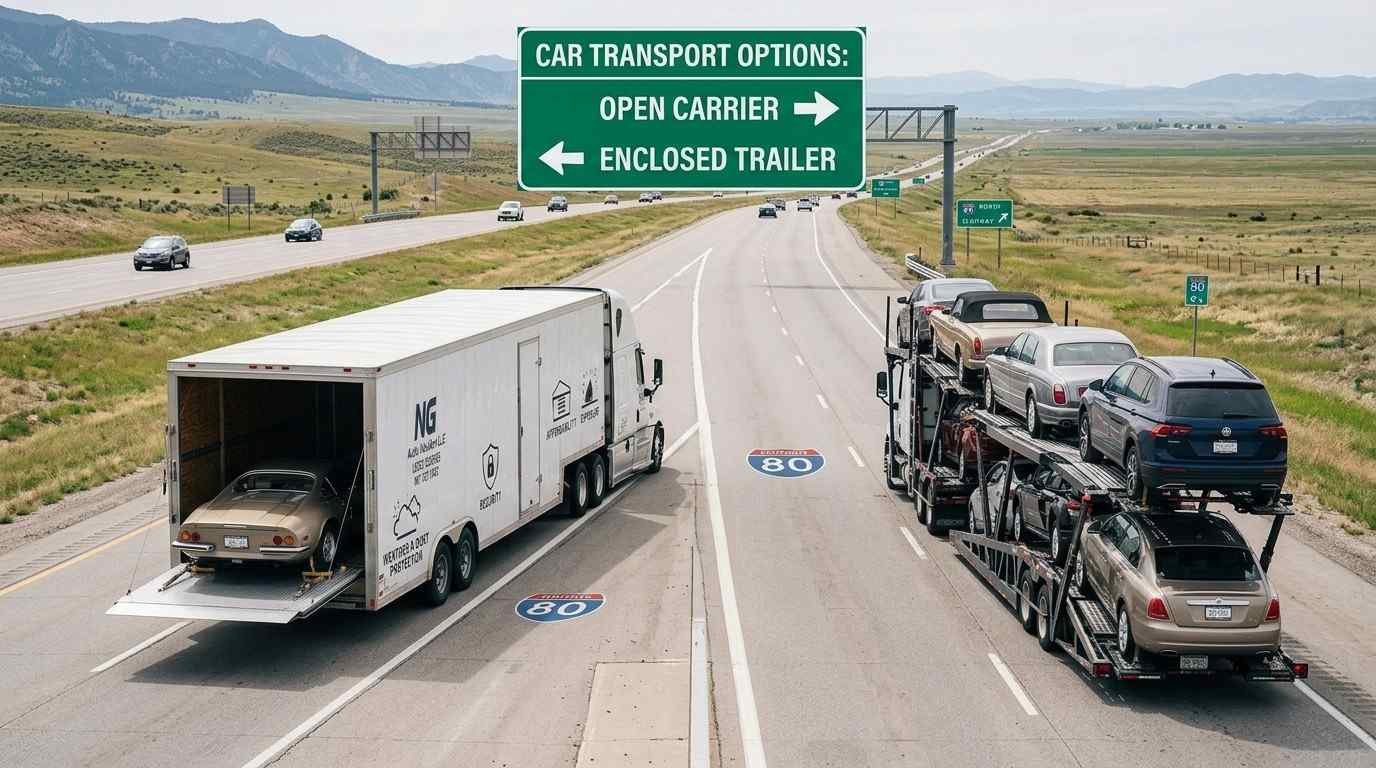
When you start looking into car shipping, you will probably run into the same question sooner or later:
Should I ship my car on an open carrier or use an enclosed trailer?
The answer is not the same for every vehicle.
For a regular sedan that you drive to work every morning, open transport may be all you need. But a restored classic sitting in your garage is a different story. You may care much more about keeping it away from rain, dust, and road debris during the trip.
That is really what the choice comes down to. You are not choosing between a “good” service and a “better” service. You are choosing the type of transport that makes sense for the car you are moving.
What Is Open Car Transport?
Open transport is the type of carrier you see most often on American highways.
Several vehicles are loaded onto the trailer, secured in place, and transported together. Because one carrier can move a number of cars on the same trip, open transport is commonly used for everyday vehicles.
Think about a family moving from one state to another. They have a Honda Accord, a Toyota SUV, or a Ford pickup that needs to go with them. There is usually no special reason for that vehicle to travel inside a covered trailer.
Open transport is often the straightforward choice in situations like that.
The main thing to remember is that the vehicle is traveling outdoors. It will be exposed to normal weather and road conditions during the trip. That does not make open transport unsuitable for ordinary cars. In fact, it is a normal way of moving vehicles around the country.
Then What Is Enclosed Transport?
Enclosed transport puts the vehicle inside a covered trailer.
The idea is simple: keep the vehicle separated from most of the outdoor conditions it would encounter on an open carrier.
This can be appealing when the vehicle itself is important to protect. A classic Mustang, a restored Corvette, a luxury vehicle, or a collector car may deserve a different level of care than an everyday commuter.
There is also the emotional side.
Someone who has spent five years restoring a car in their garage may not look at the vehicle in the same way as someone replacing an ordinary family sedan. They may be willing to spend more to limit its exposure during a long trip.
That is where enclosed transport starts to make more sense.
NG Auto Haulers LLC offers Enclosed Car Transport for customers who are considering this option.
Does Every Expensive Car Need an Enclosed Trailer?
No.
The value of the vehicle is only one part of the decision.
Suppose you own a luxury SUV that you drive every day. It may be expensive, but you are already putting thousands of miles on it every year. You may decide that open transport is perfectly reasonable.
Now consider a rare collector car that only comes out of the garage on special occasions. You have already invested time and money into keeping it in excellent condition. In that situation, the extra protection of an enclosed trailer may feel worthwhile.
The same car can have a completely different transport requirement depending on how its owner uses it.
There is no formula that says a vehicle above a certain price must be enclosed.
What Is the Main Difference During the Trip?
The biggest difference is exposure.
With an open carrier, your vehicle travels in the open air. Rain, dust, road spray and ordinary highway conditions are part of the journey.
With an enclosed carrier, the vehicle travels inside a covered trailer.
That does not mean an open carrier is unsafe for a normal car. It simply means the two services provide different levels of protection from the outside environment.
This distinction is easy to understand when you think about the vehicle rather than the trailer.
Would you be comfortable driving the car several hundred or several thousand miles yourself in normal road conditions?
Or is this a vehicle that you normally keep covered and protected because preserving its condition is a major priority?
Your answer may tell you more than any general rule about which service to choose.
What About the Price?
Open transport normally costs less than enclosed transport.
There is a straightforward reason for that. Open carriers are designed to move more vehicles at once and are used much more widely.
Enclosed transport requires a different type of trailer and is generally offered at a higher price. The difference varies from one route and shipment to another, so it is better to request a quote for the actual vehicle instead of working from a national average.
This is where budget becomes part of the conversation.
For an ordinary car, you may decide that the additional expense of enclosed shipping does not add enough value.
For a restored vehicle, you may look at the same difference and think about it differently.
Neither decision is automatically wrong.
Does the Distance Change the Decision?
It can.
A short trip between neighboring states is one thing. A vehicle traveling from California to New York will spend much longer on the road.
The longer the trip, the more time the vehicle spends in transit and the more weather and road conditions it may encounter. That may make an owner think more seriously about enclosed transport.
But distance alone does not decide it.
A ten-year-old sedan traveling across the country may still be a perfectly reasonable candidate for open transport. A classic car making a much shorter trip could still be better suited to an enclosed trailer.
The vehicle comes first.
For customers arranging Cross-Country Car Shipping, the transport method can be discussed alongside the route, vehicle and timing.
What If You Are Shipping From California, Texas or Florida?
The same basic decision applies no matter where the car starts.
A customer using Car Shipping California may be sending a daily driver to another state or moving a collector car to a new home.
Someone using Car Shipping Texas could be transporting a family SUV after a relocation.
In Florida, seasonal moves are common enough that customers may be arranging transport for vehicles they use only during part of the year. In that situation, Car Shipping Florida and Snowbird Car Shipping provide useful starting points.
None of these locations automatically require one type of carrier. The route gives you context; the vehicle determines what level of protection you may want.
What About Illinois and Chicago?
The same thing applies closer to home.
A customer leaving Chicago with a regular family vehicle may have no reason to pay for an enclosed trailer. Someone moving a restored vehicle out of the area may make a different choice.
NG Auto Haulers provides information for customers looking at Car Shipping Chicago as well as broader Car Shipping Services in Illinois.
One thing worth keeping in mind is that a location page tells you where the service is available. It does not automatically determine which carrier you should use.
That decision still belongs to the vehicle and the shipment.
And What About New York?
New York brings another example.
A person shipping an everyday SUV out of the state may be perfectly comfortable with open transport. Someone moving a vintage vehicle they recently purchased may care more about keeping it covered throughout the journey.
Customers arranging transport from the state can review Car Shipping New York before working through the details of the shipment.
Again, the state is only the starting point.
The condition, value, use and expectations surrounding the vehicle matter more when deciding between open and enclosed transport.
Does Door-to-Door Mean Enclosed?
No. These are two different parts of the service.
Open and enclosed describe the type of carrier.
Door-to-door describes the pickup and delivery arrangement.
A vehicle can be transported on an enclosed trailer and still have door-to-door pickup and delivery. The same can be done with open transport.
Door-to-door service is about convenience. The carrier picks up and delivers the vehicle as close as practical to the requested locations, provided the roads are suitable for the truck.
NG Auto Haulers explains this option on its Door-to-Door Car Shipping page.
What If the Car Does Not Run?
That is something to mention before the shipment is arranged.
A running vehicle can generally be driven onto the carrier. A vehicle that does not start or move on its own may need additional equipment during loading.
That does not automatically mean you need enclosed transport. The two issues are separate.
You can have a non-running car on an open carrier, or a running car on an enclosed carrier.
Just make sure the transport company knows the vehicle’s condition before pickup so the right arrangements can be made.
So Which One Makes More Sense?
Here is the simplest way to look at it.
If you are moving an ordinary car and want a practical way to get it from one state to another, open transport is often the logical place to start.
If the vehicle is a classic, collector, luxury or highly customized car—and keeping it sheltered during the trip matters to you—enclosed transport may make more sense.
There is a third possibility too: you may simply want more information before deciding.
That is completely reasonable.
Look at the vehicle. Think about the route. Consider how much protection you want and what you are comfortable spending. Then compare the actual options available for your shipment.
Choosing a Transport Option With NG Auto Haulers LLC
At NG Auto Haulers LLC, the transport method can be discussed around the vehicle and the journey rather than treating every car the same way.
A standard vehicle may be suitable for open transport. Another vehicle may call for an enclosed carrier. The route, pickup and delivery locations, condition of the car, and your preferences all belong in that conversation.
You can review the company’s Vehicle Transport Services to see the available options and use the Get a Quote page when you have your vehicle and route information ready.
The Simple Answer
There is no universal winner between open and enclosed car transport.
Open transport makes sense for a large number of everyday vehicles because it is widely used and generally costs less.
Enclosed transport is worth looking at when protecting the vehicle from outdoor exposure matters more than keeping the transport cost as low as possible.
The best place to start is not with the carrier.
Start with the car.
Once you know what the vehicle needs, the rest of the decision becomes much easier.