
If you are thinking about shipping your car, the first thing you probably want to know is the price.
The problem is that there is no single number that applies to every vehicle. Shipping a sedan from Florida to Georgia is a very different job from moving a pickup truck from California to New York. Even two similar cars traveling between the same states can receive different quotes depending on the carrier, the pickup location, the time of year, and the type of transport.
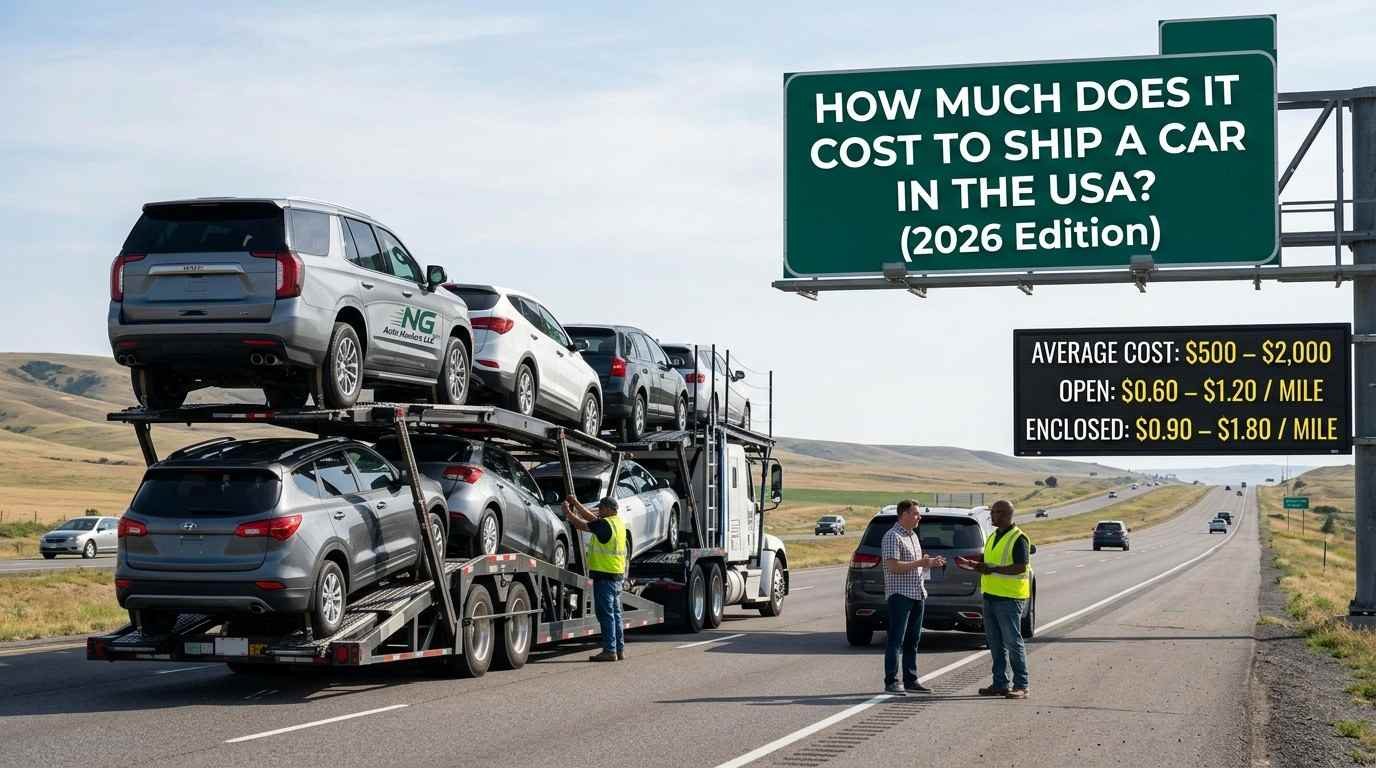
For 2026, recent industry data places the average cost of shipping a vehicle in the continental United States at roughly $1,100 to $1,200. Sherpa’s data from more than 335,000 actual shipments puts its overall average at $1,193, while Move.org reports an average of about $1,128 based on its research. These numbers are useful for planning, but they are not fixed rates.
So what will your car actually cost to ship? That depends on a few things.
What Is the Average Cost to Ship a Car?
For a standard, running vehicle, open transport is usually the first option people consider.
Sherpa’s 2026 shipment data shows an average of $1,238 for open transport, with typical shipments falling between about $975 and $1,450. Enclosed transport is more expensive, with an average of $1,852 in the same data.
Move.org’s research gives lower averages—about $914 for open transport and $1,342 for enclosed transport—which shows why it is risky to treat one national average as a guaranteed price. The companies, routes, vehicles, and quote samples are different.
For someone planning a shipment, these figures are best viewed as a starting point.
A short trip may cost several hundred dollars, while a long-distance shipment can easily reach or exceed $1,500. Enclosed transport, larger vehicles, inoperable cars, and special pickup arrangements can push the price higher.
Distance Is Only Part of the Calculation
It makes sense to assume that a longer trip will cost more, and generally it does. But car shipping does not work like a simple taxi fare where you multiply every mile by one fixed amount.
Short trips can actually have a higher cost per mile because the carrier still has to cover loading, unloading, fuel, scheduling, and other operating costs. As the distance increases, the price per mile often decreases even though the total price goes up.
Move.org’s 2026 examples show the difference clearly. A 94-mile shipment between Greensboro, North Carolina, and Charlotte averaged about $404 on an open carrier, while a 3,038-mile shipment from San Diego to Boston averaged about $1,403.
The route matters as well. A carrier already traveling through a busy transportation corridor may have an easier time fitting another vehicle into that route than a carrier traveling to or from a remote area.
That is one reason a quote should always be based on your actual pickup and delivery locations.

The Type of Vehicle Can Change the Price
A small sedan and a full-size pickup do not take up the same amount of room on a carrier.
Current 2026 shipment data from Sherpa shows an average cost of about $1,225 for cars, $1,306 for SUVs, and $1,501 for pickup trucks. Larger and heavier vehicles generally require more carrier space, which can affect the price.
The condition of the vehicle matters too.
A running car can normally be driven onto the carrier. An inoperable vehicle may need a winch, special loading equipment, or additional handling. Sherpa’s data shows an average of $1,280 for running vehicles compared with $1,576 for vehicles that were not running.
When requesting a quote, give the transport company accurate information about the vehicle. Mentioning that a car does not run is important because it can affect how the carrier prepares for pickup.
Open Transport vs. Enclosed Transport
For most everyday cars, open transport is the option you will see most often.
Your vehicle travels on a carrier with other vehicles and is exposed to normal outdoor conditions during the trip. It is the standard choice for a large portion of vehicle shipments and generally costs less than enclosed transport.
Enclosed transport is different. The vehicle is placed inside a covered trailer, giving it additional protection from weather and road debris.
That extra protection comes at a higher price, so enclosed shipping is commonly considered for classic cars, collector vehicles, luxury automobiles, restored vehicles, and other cars where owners want to limit exposure during transportation.
You can read more about this option on our Enclosed Car Transport service page.
Does Shipping a Car Across the USA Cost More?
For a long-distance move, the total price will normally be higher than a short regional shipment.
There is more driving involved, which means more fuel, more time on the road, and a longer commitment for the carrier. But there is still a difference between routes of similar length.
A shipment between two major cities may be easier to arrange than one that starts or ends far from a common transport route.
For example, Move.org’s current data shows an average of about $1,403 for open transport on a San Diego-to-Boston route and about $1,992 for enclosed transport. That is a real-world reference point for a cross-country shipment, not a guaranteed price for every California-to-Massachusetts move.
For longer interstate moves, our Cross-Country Car Shipping service provides more information about the process.
Can the Time of Year Affect the Price?
Yes. Car shipping prices can move with demand.
Certain routes become busier during relocation season, while routes connected to winter and summer travel can see additional demand at particular times of the year. Fuel costs, carrier availability, weather, and how quickly you need the vehicle picked up can also influence the quote.
That is why an estimate you found online six months ago may not match a quote you receive today.
You may also find that having some flexibility with your pickup date gives the carrier more options when planning a route. Flexibility does not guarantee a lower price, but it can make scheduling easier.
What Should You Have Ready Before Getting a Quote?
You do not need a long list of documents just to get an initial estimate.
Usually, the important information includes:
- Pickup city and state
- Delivery city and state
- Vehicle year, make, and model
- Whether the car is running
- Open or enclosed transport
- Your preferred pickup timeframe
It is also useful to mention unusual circumstances in advance, such as a lowered vehicle, oversized truck, modified car, or limited-access pickup location.
The better the information, the more useful the quote will be.
At NG Auto Haulers LLC, you can review our Vehicle Transport Services and then provide your shipment details through the Get a Quote page.
What About Door-to-Door Car Shipping?
Some customers prefer having the vehicle picked up and delivered as close as practical to their chosen locations rather than arranging separate transportation to and from a terminal.
That is where door-to-door service can be useful.
It can save you the extra trip to a terminal and make the overall process more convenient, particularly when you are moving to a new state or sending a vehicle to someone who cannot easily collect it from a distant facility.
You can learn more about our Door-to-Door Car Shipping service before deciding which arrangement suits your shipment.
Should You Choose the Cheapest Quote?
Price matters, but comparing the numbers without checking what is included can be misleading.
For example, imagine you receive three quotes for the same car. One is noticeably lower than the others. Before booking, check that all three quotes are based on the same pickup and delivery locations, the same vehicle information, and the same type of transport.
It is also worth asking questions when something seems unusually cheap. Was the quote based on open or enclosed transport? Is the vehicle information correct? Are the requested dates realistic?
A quote is much easier to compare when you know exactly what service it represents.
Why Get a Personalized Quote?
An online average can help you prepare a budget, but it cannot tell you exactly what your own shipment will cost.
Your vehicle, route, pickup location, delivery location, transport method, and timing all come together to determine the actual price. That is why a personalized quote is more useful once you know where the car is starting, where it is going, and what type of vehicle you are shipping.
NG Auto Haulers LLC provides vehicle transport services for customers moving cars between states and across the country. If you are planning an interstate move, you can also explore our State-to-State Car Shipping service.
Final Thoughts
So, how much does it cost to ship a car in the USA in 2026?
For budgeting purposes, around $1,100 to $1,200 is a reasonable starting point for a typical shipment, based on recent industry data. But your actual quote could be lower or higher. Open transport generally costs less than enclosed transport, while larger vehicles, inoperable cars, longer routes, and certain scheduling or location requirements can increase the price.
Instead of trying to find one national price, start with your own route and vehicle details.
That will give you a much clearer idea of what shipping your car is likely to cost.
When you are ready, you can request a car shipping quote from NG Auto Haulers LLC.